Monday, January 24, 2022

Why Accountability Fails - Will Fail By Syed Shabbar Zaidi

 Why Accountability Fails: Will Fail By Syed Shabbar Zaidi The Prime Minister Imran Khan admitted recently that the PTI government has not been able to conduct accountability, so far, in the desired and expected manner. This is tragic for Pakistan. Nevertheless, it was not unexpected for me for the reasons given in the following paragraphs of this article. It is highly important for Pakistan as a state to understand that Pakistan is faced with state-sponsored legally protected modes of corruption. Politicians and media, without understanding the ground realities and legal system give hope to the simple people of Pakistan that there will be some sort of accountability for the corrupt people and for obvious reasons they miserably fail which creates hopelessness about the prevalence of rule of law in this country. This has happened in this country repeatedly since 1947 ( we have EBDO way back in the 1950s) and recent examples are accountability drives undertaken by Senator Saifur Rehman against the PPP government, General Pervez Musharraf and General Amjad against politicians and businessmen at large in the 2000s and now by the PTI government against the past political governments. In my personal view, at least in the last two cases, there cannot be any question on the sincerity of efforts. However, the failure and delay is obvious and for valid reasons. This requires a proper understanding of the prevalent financial and taxation system of Pakistan which has been designed by vested interests in a manner that there can never be proper accountability against corruption. It is the den of mischief duly protected by strong trip wires which start alarming whenever there is an intruder in the system to correct the malfeasance. This subject which is completely non-political has been discussed in the following paragraphs. Pakistan has not been well-governed since 1948. However it is the observation and belief of a common Pakistani that the rule from 1970 to 2021 is full of corruption and those involved, irrespective of political affiliations and status, are to be made accountable before the people. The organised legally protected corruption accelerated after 1992. This was the result due to which Pakistani rupee which had a one rupee margin against the Indian rupee in 1995 (Pakistan 32: India 31) is now 178 against 75 Indian. The accountability of people involved in financial corruption is a very difficult and complex task. Throughout the world, the only law which can bring a delinquent person within the clutches of law is the income tax law. The Sicilian Mafia chief could not be brought to justice under any law, even under the well-established law of the United States of America, except income tax laws and he was convicted under that statute. The simple tax question universally acceptable is the identification of sources of money used for lavish living. This is a universal principle that cannot be changed. Why this universal principle cannot be applied in Pakistan and what has been done in Pakistan which has made accountability almost impossible in Pakistan is explained in the following paragraphs. In my opinion, those who designed the taxation system in Pakistan after 1992 have comprehensively studied the case of the Sicilian Mafia chief with respect to the fact that they can be caught on account of their unexplainable sources of funds used for lavish living. The only manner through which any kind of financial crime can be made accountable is the examination of means of living. Now in this post-1990 Pakistan, this question has been erased from our tax dictionary. Therefore whilst designing the absolutely intellectually corrupt system which became prevalent after the 1990’s the question of explaining the sources of ‘living beyond means’ has been made irrelevant. The upfront conclusion is that Pakistan has been utterly destroyed by way of ‘state-sponsored corruption’ through legislations in the fields of income tax and foreign exchange which allowed everything illegal in the guise of legally permitted manners. This is exactly what I stated before the Supreme Court as amicus curiae in the PanamaGate scandal case. [Supreme Court Sou-moto case 2 of 2018]. This discussion is not being made to repeat history or to create further hopelessness. The only purpose is to tell the public at large that those who understand the system, like me, are fully aware of the reasons why accountability is failing and it is our duty not to create unnecessary hopes. Our emphasis should be on corrections for the future as almost all the wrong practices are being continued. This is quite apparent from the tax directory of parliamentarians for 2019 the period of PTI government. Under the modern world if the rulers are corrupt and they want to avoid corruption then the first thing they do is to destroy the taxation system. This has been done in Pakistan in a very discrete and organized manner and our people and also the courts could not find and distinguish the fine line between ‘simplicity’ in the taxation system and ‘non-documentation’. In the name of creating simplicity, everything else in the system has been destroyed. There is no other example of this state-sponsored corruption in the world. It is my personal experience as President of the South Asian Federation of Accountants that those who understand the ABC of taxation system laugh when they see the applicable tax code for Pakistan for major sectors of the economy. This system has been intentionally designed to kill documentation and to avoid the possibility of a question of ‘living beyond means. If we want to understand the system of state-sponsored corruption, in summary, then we require a simple understanding of the following three laws enacted by the parliaments of Pakistan and approved wholeheartedly by the then judiciary of Pakistan. These laws were inherently wrong, purposefully fabricated against the common man and were part of a joint venture of corrupt politicians against the common man of Pakistan. These people are still sitting in the parliament and sit on both treasury and other benches of the parliament. The drama of national destruction staged after 1992, scene by scene, is as under 

1. The first scene is the introduction of the ‘Presumptive Tax Regime’ in the 1990s by the then Nawaz Sharif government. Under that law, the universal principles of taxation of income were raped. Under this system which is not applicable anywhere else in the world, a particular sum not being the ‘income’ was treated as income and that amount was treated as a final discharge of tax liability. It in fact means that there is no ‘direct tax’ on that income. There is only an indirect tax in the shape of withholding. Pakistan may be the only country where direct tax has been abolished by the law of parliament. This is totally criminal. Through this system, the link between the ‘income’ and ‘tax liability was broken. Accordingly, the inquiry about sources of income became impossible. For example, I have to pay Rs 6 on the Rs 100 of the value of goods imported by me for trading. The state is not informed and concerned whether I have made Rs 50 as ‘profit’ on that transaction or has made a ‘loss’ of Rs 10 or whatever it is. Under this system, there cannot be any identification of any source of income or assets. For example, I can have assets worth billions and on inquiry, I can easily say that this billion is the result of a business that is under a presumptive tax regime or a gift from my son or brother engaged in a business subject to presumptive tax. The best example is the export business of Pakistan worth USD over 25 billion. If I had paid the withholding then no other question can be asked. In simple terms, the amount paid as tax is the cost of laundering money if I am interested in doing so. The Institute of Chartered Accountants where I was the President strongly resisted this law however we were unsuccessful. Subsequently, this matter was taken to the Supreme Court, but like any other case, such as a Moulvi Tamizuddin Khan case the ‘law of necessity was applied and the Bench headed by honourable Justice (Late) Ajmal Mian in the case of Elahi Cotton Mills Limited [1997 PTD 1555] case validated the most absurd law in the history of taxation. Now the question is whether parliament or the judiciary is responsible for this crime. In my view, both are equally responsible and simultaneous responsibility rests with the professional community, including us, who accepted the most dangerous enactment made in the country. When I became the Chairman Federal Board of Revenue in 2019 through the Finance Act, 2019 I tried my best to undo the mistake and substantial heads were taken out of the presumptive tax regime. But remaining continued due to political expediency. Nevertheless, in the intervening period, the damage had been done and Pakistan as a country had no record of total income earned by its businesses from 1990 to 2019. This is in trillions of rupees. Now the question is whether any accountability can be done with respect to corruption money that had been and still can be legally disguised under the income subject to presumptive tax. The answer is negative. Very few people realize the intensity of this error which has been made in the guise of simplification of laws. It is a 100% case of intellectual corruption of the person who suggested and drafted that law, those who enacted it and those who declared it as legal whilst sitting on the honourable benches. It has been repeatedly explained by me that money laundering has been made legal in Pakistan after 1990. The anti-money laws are effectively toothless for funds so laundered under a presumptive tax system. The conclusion of this part is that there cannot be any accountability for corruption money earned as it is in the pool of unrecorded business income which was subject to presumptive tax during the period 1990 to 2021. The amount is in trillions. So it is very easy to include one or two trillion rupees of corruption money in this kitty especially when the politicians and their families are both in business and politics. This is a joint venture. Under the present Pakistani system it is preferable for political families to be in business so that there is a legally permissible manner of placing the corruption money in the record as income subject to presumptive tax. In this situation, I reiterate that before embarking upon the accountability for the period 1990 to 2021 there has to be a proper understanding of the taxation system that prevailed in the country. There is an unexplained pool of trillions of rupees out of which billions cannot be taken as corrupt money. Almost 80 to 90 per cent of houses in DHA in Lahore do not appear from any explained source. This is an undeniable fact that requires a fundamental paradigm shift as discussed below. 

2. Our corrupt people were not satisfied with the legally available laundered corruption money in Pakistan. They wanted the same outside Pakistan in dollars. In order to do the same the most notorious law in the history of foreign exchange laws of the world under the name ‘Protection of Economic Reform Act,1992’ (PERA) was introduced. This overarching law which placed all the foreign exchange regulations as contained in Foreign Exchange Regulations Act, 1947 virtually in the dust bin consisted of only one and a half pages. Our rulers were interested in simple and short laws. After the enactment of this law, two parallel foreign exchange regimes became operative in the country. In simple terms, the foreign exchange laws during that time operated in a hilarious manner. For example, if I wanted to send one million $ outside Pakistan for my genuine business or non-business purposes then it was virtually impossible to get permission which is required under Foreign Exchange Regulation Act, 1947. However, I can send ten million $ by purchasing the same from an exchange company by paying them in Rupees under PERA. Even that botheration was not required. The counters of exchange companies openly did ‘Hawala’ transactions for millions and millions. On a personal level, I am against restrictions on foreign exchange transactions however I am strongly against the system where I am not asked for the ‘sources’ of rupees that I want to send outside Pakistan. This law was specially introduced to take the money laundered by way of a presumptive tax regime and corrupt money outside Pakistan. In this case, also the Institute of Chartered Accountants of Pakistan strongly but unsuccessfully resisted. This absurd law was duly protected by the judiciary in the famous case of the full bench of Lahore High Court headed by Justice Sheikh Riaz Ahmad in the matter of Hudabiya Engineering (Private) Limited reported as 1998 PTD 34. This means that our courts allowed sending money outside Pakistan without any enquiry about the sources. This happened from 1992 to 2018. From 1992 to 2018 I wrote at least twenty articles that this joke should be stopped. Then there was the Panama Leaks. After which I wrote a book ‘Panama LeaksBlessing in Disguise’. When these matters came to the surface then in 2018 a partial correction was made in 2018 when PERA was made subservient to general foreign exchange regulation. But the damage had been done. In this connection, it is necessary to state that Mian Nawaz Sharif is not the only person responsible for this mess. General Musharraf totally endorsed this wrong policy of Mian Nawaz Sharif and in 2001 another strange law being ‘Protection of Foreign Currency Accounts Ordinance, 2001’ was enacted. PPP being a part of a joint venture supported the same in their tenure. Now the PTI came into power with the support of electives. The party in my view was not fully apprised of the tripwires which were laid down to support this intellectual legally supported corruption. The electives were no exception to the system. Now if some politicians, bureaucrats and retired people own substantial assets outside Pakistan then that is not a strange phenomenon for a person like me. The amount that has been sent outside Pakistan is over $ 120 million in these forty years. So if someone owns assets outside Pakistan in the shape of a flat near Hyde Park then the same may be legally protected under the system explained above. In 2018 and 2019 I advocated ‘Asset Declaration Schemes’ for such assets not to catch the persons or to bring the assets back. I said the same in the open court in the Supreme Court as amicus curiae attracting annoyance from then Chief Justice Mian Saqib Nisar. These laws were introduced for future asset records in Pakistan and to save these assets from confiscation by foreign authorities like the ‘Unexplained Wealth Order’ of UK. The mistake which Mian Nawaz Sharif made regarding the alleged assets outside Pakistan after the Panama Leaks was agreeing to produce a trail of money for acquiring foreign assets. There are legally permissible means to have such money outside Pakistan without providing the sources and trail therefore he was ill-advised by his advisors which led him to unanswerable issues. Notwithstanding the aforesaid discussion, accountability by Imran Khan is very easy if there is a genuine desire by the nation. If allowed, the state can ask all Pakistanis to disclose the amount of remittance made out of Pakistan by all individuals from 1992 to 2018 from their foreign currency account. The funds to acquire assets outside Pakistan by the family of a member of the judiciary have also been sent from a private foreign currency account. If sources are proved then there is no case. If we are serious and actually want to make people accountable then as a nation we should voluntarily disclose the amount we have sent outside Pakistan from the foreign currency account maintained in our name, the names of our spouses and dependent children. If that is done for the period 1992 to 2018 all corrupt politicians, bureaucrats, forces personnel, judges, professionals and businessmen, if any, will be exposed. It is a very easy step and it does not require NAB or FIA. As a nation, we would have to see whether or not we are ready for the same. I totally agree that there is legal protection however if we want to save the country we would have to swallow this bitter pill. In case if people are not by and large agreeable then everything about accountability will not have any concrete result. If so then we should correct for the future and leave the past. This is a question of equity, not the law. 

3. The third scene of the drama is even more interesting. Money sent outside Pakistan was also required in Pakistan to the extent of the sum required to buy houses, properties, election expenses and lavish livings. The same was required to be the one ‘declared’ but not taxable. In order to do that a very strange and novel provision was introduced in the Income Tax laws by way of Section 111(4) of the Income Tax Ordinance, 2001. Under that provision, all money sent from abroad was made ‘immune’ from any inquiry about sources. My unknown relative may send me ten million $ for which no enquiry can be made if the amount is received by the State Bank of Pakistan. Known and unknown relatives and benefactors sent billions of rupees in Pakistan from 1992 to 2018. They were declared and treated as if these were taxed paid sums. Again the Institute of Chartered Accountants of Pakistan and I in my personal capacity unsuccessful voiced the discontinuation of perennial sources of money laundering. Nothing was taken into account however ultimately after the Panama Leaks a reasonable caveat has been placed in this section. Nevertheless, the result of this immunity between 1992 to 2021 was the availability of trillions of rupees in the economy of Pakistan which were untaxed. This black, grey or white money whatever it is called was again used to generate black money resultantly at present around 40% of GDP consist of the undocumented sector. This was all legal means to convert corruption and untaxed money into white money in the country or if desired retain it as grey money. Again in case if the nation is serious about accountability then it should ask all Pakistanis to voluntarily disclose how much money they have laundered/sent through the application of Section 111(4) of the Ordinance. It is simple accountability that does not require NAB or FIA. It requires political and state will on the matter. The aforesaid discussion may not be easily understood by people not acquainted with tax and foreign exchange laws. Accordingly, this has been explained in the form of simple illustrations as under In my article printed in this paperback in 2018 I termed these three provisions as ‘Unholy Triangle’ for legally permitted corruption which makes accountability a farce in this country. Now when we see the cases under investigation in NAB we find that in most of the cases they reflect funds received from abroad in the name of ‘Benami’ persons. Which are peons, chowkidars etc. This is Step 3 in our illustration. The problem that will arise when these cases will mature will be that prior to 2019 Benami transactions were legally permissible in Pakistan. It was only in 2018 these were made illegal. The fundamental question from a legal viewpoint that will occur whilst investigating these cases will be the charge against the recipient if he or she claims to be a Benami. In my opinion, the cases will be weak to prosecute. The gist of the discussion, as above, is to identify that those who did corruption from 1992 to 2018 were fully aware of the consequences that were supposed to arise after they were not in power. They foresaw the future and legally protected them in a manner that no accountability could be done. In this manner, the whole elite benefitted. The problem with the present government is not examining the cases in this context and conveying a sense that there will be a conviction in future. The failures being faced by the present government in the field of accountability are not on account of any incompetence. They are the result of strong trip wires placed by the earlier rulers by way of legal protections. This should be told to the people at large. However, the question that remains unanswered is whether the parliamentarians who are in power and in opposition are in any manner different from those who framed the laws as described above. The answer is negative. The tax directory of 2019 reveals that over 200 persons in parliament do not have any income other than the salary they receive from the government. In the past, the first step was making the wrong laws. Can there be any possibility of a proper enactment in future when the same people are sitting in the parliament with a different cloak? The answer is negative. The solution, therefore, lies in a complete change in the paradigm of national thinking on financial matters. If the nation is not ready to voluntarily disclose the funds transferred out of foreign currency account from 1992 to 2018, or the amount received out outside Pakistan claimed under section 111(4) then the hopes about accountability should be kept low or completely extinguished. I understand that there is no legal basis to do so and courts will have the right to stop the same if mandatorily required. The question for Imran Khan and PTI if they are ready for an overall probe is whether they support complete transparency for the past. In the manner proposed there will be no charge of selectivity. I reiterate that the only way to check the same is the inquiry about ‘living beyond means. To conclude the subject I state that Pakistan has been systematically and by design destroyed and corruption has been legally protected. Chances for unearthing the past are remote when there is an inherent desire to maintain the status quo by all parties and relevant people. My sincere advice is to save Pakistan from collapse and give hope to its young generation, otherwise, there will be undesirable consequences.

Wednesday, December 15, 2021

Who am I

 My Introduction


Who am I: 

A pensioner from Pakistan Army, born in Baltit (Karimabad) Hunza, GB.


What do I do: 

Ever since my retirement in 1999, I have started developing IDEA DEMONSTRATION PROJECTS towards attainment of BETTER TOMORROW  goals - set by MHI - through SELF HELP and efforts by individuals, LSOs,JIs, NGO’s as well as sponsorship by the government institutions.


SUMMARY:

1. Energy Starvation in our region:

  1. Pilot project in Khurukushal KHAN for 54-household - distributed emergency solar system.

  2. Enhanced 25-KW model solar backup project at Baltit through PUBLIC PRIVATE PARTNERSHIP GB W&P department, Agreement in process since July 2021 for cooperation to integrate through public distribution system  and  operation by TMS.

  3. FLOATING HYDROELECTRIC GENERATOR and pumping station. Prototypes - 4 variants - developed for emulation. Features village level technology, low cost of generation - only around Rs 95,000/00 as compared to Rs 1,300,000.00 to 1,600,000 per KW needed in building mega projects. 

2. Human Resource development: “KNOWLEDGE SOCIETY INITIATIVE” through:

a. the state of art resource centers established by the government, AKDN - 14, Chinese - 6 and LSOs.

b. Demonstration Facility at my residence for replication to impart free of cost world class education and skills - specially to poor populations. This facility integrates a DIY satellite receiver to download free of cost digital files from OTHERNET satellite system and also to serve a maximum of 6-beneficiaries within wi-fi range of 10-20 meters. A new gadget titled BIG BOX, capable of enhancing the range to 100 m and simultaneous service to more than 50 beneficiaries has been donated free of cost by a firm in England. This new gadget, however, has got stuck up wth custom authorities at Lahore Airport. 


3. TELEMEDICINE: 

Basic sensors for such a facility have been integrated at the facility in 2b above. Advocacy is on going for service through TKN - TIME & KNOWLEDGE NAZRANA - by professionals and implementation through JIs.


4. RECOGNITION - ROLL OF HONOUR


Invitation to Attend the Dubai Leadership Summit & Nomination to Receive Honorary Doctorate Degree London Graduate School Wed, Feb 2, 10:31 AM (1 day ago) Dear Brig. Invitation to Attend the Dubai Leadership Summit & Nomination to Receive Honorary Doctorate Degree – March 29-31, 2022 The London Graduate School and Commonwealth University of Business Arts and Technology are excited about the upcoming Dubai Leadership Summit scheduled to take place from March 29 – 31, 2022. We organise a wide range of events that bring together top executives, business leaders and other professionals across the globe to share knowledge, support learning and to provide networking opportunities.


Thursday, August 26, 2021

Summary of My Advocacy for our Region

  1.  ADVOCACY - FOR HUNZA  For the communities through SELF-HELP:
         A.    ROAD-MAP:    This post proposes a ROAD-MAP with the aim of goading the populations in the region to start a journey which can result in  a desirable situation for the present and coming generation.

        B.    DISTANT EDUCATION AND SKILLS:    KNOWLEDGE SOCIETY INITIATIVE - In the digital age world class education as well as skills are universally accessible as such depending on BRICK and MORTAR facilities of questionable standards will fail to prepare competitive HR for a global world. There is definite need for reorientation towards methods and facilities made accessible by technology. 2020 is going to be a year of high speed change in emerging technology. Advocacy on Teaching, Learning and Networking through the State of Art Learning Centers in GB. UNESCO REPORT

https://x.com/csgbpk/status/1707263332393095306?s=20


        C.    Home Tutoring: Free of cost world-class education and skills at door-steps (ECD to PHD)

        D.    Hunza Culture: BHT Entrusted to the promotion and preservation of cultural and historical heritage of this part of world. 

        E.    Floating Hydroelectric Generator & Pumping Station: Indigenous designed generator which produces cheap and sustainable energy directly from slow moving water in man-made water channels, natural rivulets, rivers and canals throughout Pakistan (anywhere in the world).

It produces cheap electricity for the region and beyond through technology implementable at village level, at the same time meant for pumping water to irrigate barren land all over GB thus creating a potential for poverty alleviation and thousands of jobs in coming decades. Concrete Proposal towards Hunza Power Supply Company

        F.    ON-LINE DISSEMINATION OF TALIMAT: Comprehensive set of books covering Ismaili Faith and Practice, The programme of education that examines Islam as both faith and civilisation in world history and in contemporary times.
        G.    Mandates and Coordination of social organizations namely TMS, BHT, BRSO, KWA with Jamati Institutiions and adoption of civil society learning Material as basis of operating procedures.

        H.    LIFELONG LEARNING & USE OF STATE OF ART FACILITIES established by the Government, AKDN and Chinese.
        I.    POLITICAL ACTION:    I have been advocating "political action" through civil society in preference to the divisive system of political parties. It is apparent that this theme is not accepted by vast majorities and questions have been posed as to how progress for the society is possible by deviating from this commonly adopted course. If you go through the happiness index for the countries, you will find Switzerland in the lead. I have posted this article as a good example of "direct democracy" results over the divisive and nonperforming "INDIRECT DEMOCRACY" system that we have inherited.


Switzerland is a direct democracy, where the people can influence the activities of government through initiatives and referendums. The political process is played out at three levels, federal, cantonal and communal.
        J.    ATTAINMENT OF DIAMOND JUBILEE GOALS
K.  IDEA DEMONSTRATION PROJECTS: 
e Imam has set four goals and how to achieve these.I have developed the "idea demonstration projects" and my ideas on how to implement for wider impact. Now all those interested on this topic can visit the site of these projects see them clarify any question, share better ideas and implement the way they deem more appropriate.
I hope the idea demonstration projects convey gist of following important messages to the populations in our region:
2.    With Decision Makers in our Country:
        A.    ENERGY STARVATION:
        B.    LEGISLATION ON:    Vital step towards Preservation of Economical Interests of GB.
            (1)    DISTRICT & VILLAGE GOVERNMENTS. Putting local communities at the centre of their own development means that interventions will be directly relevant to their needs, and contribute to long-term sustainability. They must be given the ways and the means to take responsibility for its own future.Self Reliance is a big part of the ethics THAT OUR FAITH ADVOCATES.
            (2)    CUSTOMARY LAWS
            (3)    NATURAL RESOURCES.
            (4)    REPEAL OF GOP ORDER 2018
        C.   Education and skills – Date 30th October 2018, Code: Gb301018-0141513,
        D.    Revolution in Teaching, Learning and Networking– Date 01 January 2019, Code: PU010119-0864448,
        E.    Constitutional Status of GB –Date 05 January 2019, Code: IS050119-0923605
        F.    Free High Speed Internet in Hunza: 14 January 2019, Code: IS140119-1054135; 
        G.      Difficulty in initiating a complaint from GB - District & Tehsil names missing: CODE: ISO30219-1316735 03 Dated February 2019 - STATUS: Resolved.
        H.    Floating Hydroelectric Generator and Pumping Station: ISO80319-1773215, Lodged on 08 March 2019: initiated on 3rd February 2019 from system to prime minister of Pakistan

        I.    DSL Internet in Hunza - GB240219-1635451: Feb 25, 2019: PTA-WEB-70125-2019 and  PTA-WEB-70122-2019, 16 Oct 2019:
        J.    Bureaucracy bent on making this modern tool for accountability ineffective CODE - PU140519-2691142, Dated May 14 2019,  reopened by the Prime Ministers office.

        K.    Withdraw the GOP Order 2018 and allow the legislative assembly to formulate laws: CODE: GB-140519-2692109 Dated 14th May 2019; STATUS: Initiated.
        L.    Complaints on citizen portal CODE: ISO-10519-2505144 Dated 01 May 2019; Complaint on Citizen Portal and meant for the PM gets referred to non-concerned Chief Secretaries  
STATUS: Assigned to PM Pakistan.
        M.    Implementation of Law on Tax in GB, must follow the constitutional integration of citizens: CODE: GB290619-3382557; June 29, 2019:
        N.    KP290220-6998374, Complaint has been assigned to IG PoliceKP.
Mar5 2020: 
        O.    CODE GB 160820-87139473, dated 16th August 2020; Promotion of Tourism and Gun free Status - Initiated,
        P.    CODE: GB281120-87634216 Dated Nov 28, 2020; Proposal for PRIORITY LEGISLATION; GB Assembly to attempt Legislation on DISTRICT & VILLAGE GOVERNMENTS and CUSTOMARY LAWS to protect NATURAL RESOURCES from exploitation of sharks from outside the region. Repeal of GOP order 2018 which has paved the way for this exploitation. Initiated by SYSTEM and referred to Chief Seretary Gilgit Baltistan.
        Q.    CPEC Authority and Representation of GB. COMPLAINT DETAILS:

CPEC is expected to be a game changer in economical uplift of populations - specially the poor regions. Since 1982 AKDN has introduced efforts through CIVIL SOCIETY to achieve three goals for the povert stricken populations through SELF HELP - STRATEGY: Organize populations in terms of VOs/WOs as well as 72 LSOs that will direct their efforts preferably as a NETWORK throughout GB.

In this scenario it is but natural that collective representation in the CPEC AUTHORITY should be ensured through this collective body rather than any other option. 

Suggestion code:  SIS311220-7124533

Dated 31St Dec, 2020, Registered, Initiated and assigned to Joint Secretary - China.

January 28, 2021: Remarks of PMDU: Dear citizen thanks for choosing Pakistan Citizen Portal

to raise your concern. Your complaint has been forwarded to concerned authorities/departments

for timely resolution/action as per facts/merits 

thanks and regards.

Mar 1, 2021: FROM Project Director (CPEC) : Closed - Partial relief granted.

Oct 13, 2021: From Prime Minister of Pakistan to Project Director (CPEC)

REMARKS:

Dear Officer,

the instant complaint was resolved by your office on 01/03/2021 13:21 with status of 'Partial

Relief Granted'.

Since a considerable time has lapsed and this office hopes that full relief would either have been

granted or near to be granted. It therefore warrants to reopen the complaint irrespective

of the citizen's feedback and to ask you to update this office as well as the citizen with recent

development regarding the complaint. In order to determine the actual status of relief, a fair

review is needed at your level so as to ensure merit with factual disposal of the case.In case,

final relief falls in the domain of any other department then forward the same for the requisit

action while mentioning the needful done at your level.


Monday, January 25, 2021

ON-LINE DISSEMINATION OF TALIMAT

 TALIMAT

The IIS Secondary Curriculum, GOOD NEWSUSER GUIDE; SIGN IN; ALSO READ. CLOUD STORAGE, VIDEO, RELATED VIDEOS, DOWNLOAD TALIMAT BOOKS, RELATED

NOTE: I hope to continue updates in the coming weeks so that readers can download the text of the complete set of costly publications as a free-of-cost option. Furthermore, ITREB has arranged the availability of two volumes on one topic only while the remaining set is not yet available despite a long waiting time and emphasis given by the Imam of the time.

“That intellect is what separates Man from the rest of the physical world in which he lives. As we develop not only our primary education but also our secondary education, I hope that my Jamat will find great happiness in reading the new books that we will make available on the history of thought, the history of faith within Shia Islam.  This notion of the capacity of the human intellect to understand, and to admire the creation of Allah will bring you happiness in your everyday lives. Of that I am certain." 

 MHI, 17 August 2007 

"Since 1957, it has been my objective to retrieve from our history and strengthen, by present day endeavours, the magnificent Shia Imami Ismaili identity and its inter-relationships with other Muslim schools of interpretation, thought, and practice of the faith. I feel that, at this juncture in the Jamat’s history, when different traditions are beginning to converge, it is particularly important to bring forward those aspects of faith and practice, including diverse forms of devotional expression, that are rooted in the Shia Ismaili Tariqah of Islam as interpreted by the Imam-of-the-Time. "

MHI - 13 December 2008 

The Secondary Level Curriculum developed by the Institute of Ismaili Studies is an international, multilingual programme in religious education and the humanities for the global Ismaili community. It introduces Ismaili youth to a modular programme of education that examines Islam as both faith and civilisation in world history and in contemporary times. The curriculum approaches the study of Islam in general, and the Shia Ismaili tradition specifically, from humanistic, civilisational and normative perspectives. Students are guided to explore aspects of Islam that relate to religion, ethics, thought and culture in Muslim societies and the Ismaili Tariqah within a broad educational framework. The modules in the curriculum are based on a study of selected facets of Muslim societies, in the past and present, including their interactions with other civilisations and cultures. The content is interwoven with thematic strands which reflect a wide range of human endeavours and pursuits that have found expression in Muslim societies and Ismaili contexts. Among the subjects covered are civilisation and society, encounters in Muslim history, Muslims in the contemporary world, intellectual traditions, ethics and development, faith and practice, the Qur’an and its interpretations, and the literature of Muslim traditions. In dealing with these subjects, the curriculum aims to address themes that are of relevance to the youth and their communities in different regions of the world.

To achieve its aims, the curriculum applies pedagogical approaches consonant with its philosophical framework. It calls for a profile of teachers with a broad set of proficiencies – a profile that is not narrowly specialist but reflects an acquaintance with a range of subjects and contexts. For this purpose, the secondary curriculum is taught by professionally qualified teachers who have been specially trained to guide students in studying Islam and the Ismaili tradition at the secondary level. These teachers are graduates of the Secondary Teacher Education Programme (STEP) who receive two postgraduate awards (Level 7) in the subjects of Islamic Studies and Education. The curriculum for the secondary level is intended for the 12-16 age group, and can also be extended to 17-18 year old students. It consists of eight modules, presented through student textbooks and teachers’ guides. The materials endeavour to impart the content through pedagogical approaches that are creative and intellectually engaging for both students and teachers.


 This module introduces the rise and development of Islam, from the period of Prophet Muhammad in the sixth and seventh centuries to the rule of the Fatimid Imam-Caliphs from the tenth to the twelfth century. Students are introduced to people, places and events of significance that came to shape the first six centuries of Islam, beginning with its genesis in Mecca and the establishment of the early caliphate in Medina, and tracing the growth of dynastic empires in Damascus, Baghdad, Cordoba and Cairo. Using the city as a space of dynamic creativity, the content presents the flowering of Muslim civilisations in all their manifold aspects. The development of Shia traditions, and the emergence of the Ismailis in this phase of history, features as an integral part of the broader Muslim narrative.

Encounters in Muslim history:

This module forms a sequel to Muslim Societies and Civilisations which covers developments from the sixth to the twelfth century. It picks up the various narratives at the beginning of the eleventh century and presents encounters and exchanges among Muslims and with other societies until the beginning of the modern period at the end of the eighteenth century. It highlights key events and figures, linking them to major challenges and achievements of each age. Analyses of the interplay of forces and influences in various regions reveals unfolding dynamics in the political, economic, social, intellectual and cultural arenas. Significant aspects of the history, thought and culture of diverse Ismaili communities during this period are interwoven into these narratives of exchanges, detailing their interactions within these systems.

Continues with the content covered in Muslim societies and civilizations. In this module we study, developments which occurred in Muslim and neighboring lands from eleventh to the eighteenth century.

We begin by the events leading up to the eleventh century, and then move on to examine significant development that followed.

The module explores the rise of new states in empires resulting from conquests, migration and settlements in Muslim lands in this period.

The history of the Ismaili Imamat that of Ismaili communities in various regions, forms an important part of this module. We will learn about the Ismailis in the Alamut period and in the centuries that followed.

A later module, entitled Muslims in the contemporary World, concludes the coverage of Muslim history in the secondary curriculum. It introduces key events and developments relating to Muslims societies from the eighteenth to the early twenty-first century.

Encounters in Muslim history thus forms a bridge between the early and modern periods of Muslim history. It highlights the diverse civilizations, cultures and traditions which arose in Muslim contexts in this intermediate period.

 Key Questions

The module explore broad questions such as:

  • How have Muslims of different times and places understood Islam ?
  • How has their understanding led to the Islam becoming adapted and expressed across different cultures?
  • What has led to the rise of a vast diversity of Muslim communities and traditions over time?


We will approach these questions and examining Muslim context from political, economic and cultural perspectives.


Open and Download


OPEN &DOWNLOAD


Open and Download

Open and Download

This module is based on the subject of devotional and ethical literature in Muslim societies. Through an examination of a range of texts across changing periods and contexts, from the formative age of Islam to contemporary times, students are led to explore the diversity and richness of literature that has developed in Muslim societies over time. Examples from a wide variety of literary forms and genres are used as illustrations to reveal the creative application of language in Muslim writings, including Ismaili contributions, in diverse contexts and cultures.

The anthological content in this volume highlights selections from the Qur’an and the hadith, passages from works attributed to the early Shia Imams, and excerpts from the writings and speeches of the contemporary Imams. Also presented here are exemplary pieces of literature from religious texts, historical biographies, moral fables, mystical poetry and devotional hymns. Drawing from diverse Muslim sources, and particularly Shia and Ismaili literature, the contents as a whole yield insight into the creative ways in which religious, devotional, spiritual and ethical themes have found inspiring expressions in Islam.


This module engages with the dimensions of religious meaning and practical expressions in a community of faith. These aspects are approached from a variety of perspectives by exploring the significance of faith, worship, devotion, ethics, religious practices, prayer, and spaces of worship and gathering in Muslim communities. Students are guided to reflect on these themes in the context of the Shia Ismaili Tariqah, and with reference to other Islamic traditions. The module seeks, as a whole, to develop insights into the role of faith and religious practice in a faith community, and in relation to the individual believer’s search for ultimate meaning.

Volume One of Faith and Practice in Islamic Traditions examines concepts of faith as expressed in a range of sources, from the Qur’an to the religious literature of Islamic traditions. A central part of this volume is devoted to understandings of tawhid and nubuwwa in Islam, and the significance of the principle of imama for Shia Muslims. The first volume also includes a study of selected facets of faith, including ibadat, divine love, and the concepts of zahir and batin in esoteric traditions of Islam.

Volume Two extends the study by focusing on the practice of the faith in Islamic traditions. Among the topics covered are the origins and development of selected rites and practices in Muslim history, the diverse forms they have taken in Muslim communities, and the meaning given to them in the practice of the faith. Also discussed in this volume are the different forms of prayer in Islam, and the diversity of spaces of worship and gathering to be found in Islamic contexts.

Ethical Pathways to Human Development:  In this module students are led to engage with the issue of social development by examining the impact of poverty, illness, illiteracy, homelessness and social injustice on communities across the world. A contextual approach is adopted to issues of development and their impact on the quality of life of people in different regions. The major part of the module is devoted to examining the institutions and projects of the Aga Khan Development Network (AKDN) as case studies of innovative approaches to development in selected parts of the world. Particular attention is paid to the spiritual and ethical ideals which underpin the concept of development upheld by Imamat institutions. Students are led to a deeper appreciation of the long, historical tradition in the Ismaili Tariqah of Imams giving institutional realisation to the ethical call of Islam.


https://www.iis.ac.uk/learning-centre/curriculum/secondary-curriculum/


https://photos.app.goo.gl/B9vzKmR9PeqWv4M38


 THE QURAN AND ITS INTERPRETATIONS:

The module engages students in a study of selected facetsof the Quran al-Sharif, beginning with it's revelation the seventh century and leading into its diverse interpretations and expressions in Muslim history. The contents of the Quran are presented at an introductory level from historical and contextual perspectives. Among the themes and concepts examined are revelation, authority and guidance;faith, ethics and social justice; and creation, spiritual quest, and the hereafter. The module also considers various positions on Quran as a source of guidance which emerged in Islamic traditions, based on different understandings of authority. This aspect is examined in greater detail in the context of Shia Islam and the principle of Imamat. A central feature of the module is the diversity of understandings of the Qur'an which has developed over historical periods and across various cultures, from theological, juridical and mystical readings to literary and aesthetic renderings.
This first of two volumes commences with a chronological examination of selected Qur'anic passages linked to the Meccan and Medinan contexts. This introduction leads into a discussion of different views on the compilation of the Qur'an into written text, and its use as a source of guidance in relation to different notions of authority which emerged in early Muslim history. Also explored in this volume is the development of the study of the Qur'an through disciplines and methods which evolved over time, including the application of tafsir and tawil to its contents. 
The final part of the volume is devoted to the concepts of authority and guidance in the Qur'an as reflected in the accounts of the prophets, and in passages interpreted by Shia Muslims as related to the principle of Imamat.
The second volume expands the study of the Quran through an examination of additional themes and illustrative interpretations in Muslim contexts.

DOWNLOADSince the file is large it will take a few minutes to appear on your screen.
TILAWAT: Listen to Surah Rahman.

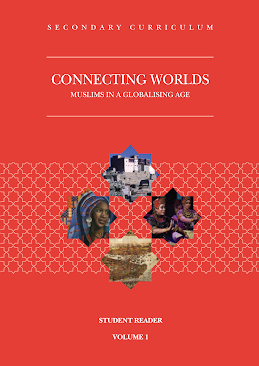
CONNECTING WORLDS IN A GLOBALISING AGE:


In this module, we examine the political, economic, religious, social and cultural transformations that Muslim communities underwent from the 1700s through the 1800s.
For Muslims, this was a time of transition and change. We explore how, weakened by internal strife and rivalries, imperial societies changed, and how traditional notions of authority were redefined, from hierarchical centralised kingships to local regional powers that allowed various elite groups and organisations to share power.
We witness an era of shifting power dynamics among Muslim societies, and also with European imperial powers buoyed by the industrial, technological and scientific revolutions. We see transformations in trade, with the decline of some trade routes and the ascendance of others, and the increased cross-cultural encounters among diverse communities of the globe.
The borders of some states became more defined, with the spread of colonisation, while others remained fluid.

NOTE: This living document links will be updated in the coming days to cover the download/accessibility of all modules.

PRESENTATION DAY-1

PRESENTATION DAY-2

RELATED DOWNLOADS TOWARDS REORIENTATION:

1. WHERE HOPE TAKES ROOT

2. ISMAILI CONSTITUTION

3. GUIDELINE BOOKLETS

4. WEBCAST

 USER GUIDE

How to Sign In to the IIS Digital Curriculum e­book platform 

  1. Go to https://islamic­ 

publications.kitaboo.eu/reader/Islamic_Publications/#!/ to access the Sign In screen. 

  1. Enter your login credentials sent to you by email to sign in. 

  1. You can check your password by clicking on the show/hide icon. 

  1. Click on the Sign In button to view your bookshelf. 


NOTE: To enable the ‘Sign In’ button, the username should be a minimum of six characters, and the password should be a minimum of eight characters. 


Manage Password 

How to reset a forgotten Password 


In case you have forgotten your password, you can retrieve it from the Sign In screen. 


  1. Under the bottom right corner of the Sign In button is the Forgot Password link. 

  1. Select the link, which will lead you to the screen for resetting your password. 

  1. Enter your registered email address to receive an email to reset your password. 


How can I change my Password 


  1. Access your Profile from the main Bookshelf screen. 

  1. Click on the Change Password link. 

USEFUL TIPS

  1. The Online Reader is optimised for viewing on a desktop or laptop computer. Some features may not be clearly visible on a mobile device.
  2. Posters and Picture Cards in the Primary Ta‘lim curriculum are best viewed in the Single Page View.
  3. Set your browser’s default zoom at 100%. If you need to zoom in or out, use the ebook Reader’s Zoom tool.
  4. There are two different search tools on the platform. The Search tool in the ‘Home Screen’ searches a keyword across all the curriculum materials and lists all the items that contain the keyword. The Search tool in the ‘Reader’ searches a keyword within the particular item that is open and lists the pages where the keyword occurs.
  5. The Highlight tool is currently not available for the Preschool and Primary Level materials. However, you can use the Pen tool to identify and mark the selected passages.
  6. The Pen and Highlight tools offer two ways of marking passages, using different colours. You might want to create your own colour codes (e.g. green for discussion points, blue for primary sources, etc.). This will help you to organise and easily identify your marked passages.